
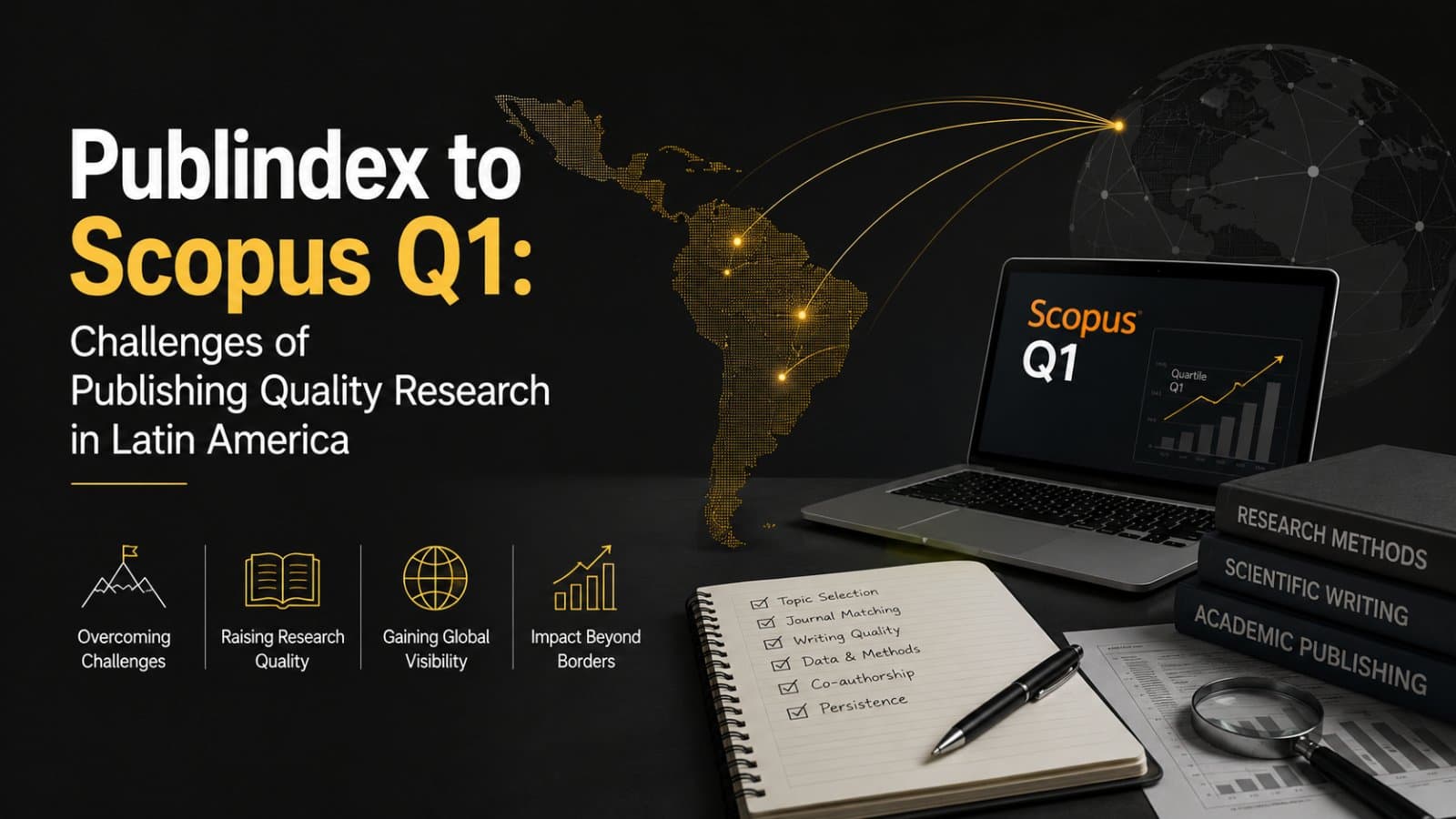
“Why does a good paper from a Latin American lab still struggle to get noticed globally?”
This is the dilemma faced by so many academics working in Colombia, Peru, Mexico, and Brazil.
They work well within their academic communities. They follow all the guidelines of their national systems. However, being part of a top Scopus Q1 journal remains like crossing the mountains blindfolded.
This blog attempts to help them scale these mountains from Publindex in Colombia to Scopus Q1 journals.
What Is Publindex?
Publindex is the journal classification system for Colombia. It was developed by Minciencias, which classifies journals from Colombia in four classes, namely A1, A2, B, and C. A1 is the highest class, whereas C is the lowest class.
The system considers editorial control, the quality of the peer review process, and the journal's visibility and citations both nationally and internationally. But it is not a mere formality. Journals that fail even one requirement in later evaluation phases get dropped from the process entirely, no matter how long they've held a good ranking.
However, the process of classifying journals is carried out in stages as well. The first stage involves the submission of materials from editorial boards showing the publication regularity, peer review procedures, and indexing data. The journals passing through this stage are then subject to citation analysis involving the calculation of indices such as the H5 index, Journal Citation Reports, and SCImago Journal Rank.
In particular, this difference is frequently not well understood by young academics. They tend to think that if their work is already well known and cited in national journals, there is no difference between publishing it in international and national journals.
On the contrary, it takes a different attitude when it comes to switching from national to international citation. Namely, it means changing the approach to writing articles for reviewers who know nothing about your institute, research, and even country.
It's Not Just Colombia: Similar Systems Across the Region
Publindex is a Colombian system specifically, but the underlying tension- a national ranking that doesn't map cleanly onto Scopus- shows up across Latin America in different forms:
- Peru: Peru operates RENACYT through CONCYTEC, which categorizes researchers—not journals—into levels such as Investigador and Distinguido, as well as several other numbered categories, based on points earned through publications indexed in Scopus, Web of Science, or SciELO, patents, and thesis supervision.
- Mexico: There is the SNI (Sistema Nacional de Investigadores) in Mexico, overseen by CONAHCYT, where researchers are rated as Candidate or National Researcher from Level I to Level III, and Emeritus, traditionally putting a lot of emphasis on international citations, but recently taking into account national publications as well.
- Brazil: there is the Qualis system, which is organized by CAPES. Under this classification system, journals are ranked using eight categories (A1, A2, B1-B5, and C) based on their different impact factor ranges. This is a ranking process that has been criticized for being one that ranks some journals far too high compared to Scopus CiteScore.
The pattern continues: every country created its own system of national recognition for research production and now has to deal with the same fundamental issue – how accurately does the national tier correspond to international reputation in Scopus and Web of Science?
They do not fit perfectly together, and it is precisely this imperfect match that ties research publication challenges in Latin America together.
Publindex vs Scopus Quartiles: A Quick Comparison
| Aspect | Publindex (Colombia) | Scopus Quartiles (Global) |
|---|---|---|
| Managed by | Minciencias | Elsevier |
| Categories | A1, A2, B, C | Q1, Q2, Q3, Q4 |
| Scope | National journals | Journals worldwide |
| Basis | Editorial quality, visibility, national impact | Citation counts (CiteScore, SJR) within subject area |
| Used for | Local funding, promotion, academic ranking in Colombia | International reputation, tenure, grants abroad |
| Update cycle | Roughly every 1–2 years (convocatoria) | Annually |
| Regional equivalents | RENACYT (Peru), SNI (Mexico), Qualis (Brazil) | Same Scopus quartile system applies to all countries |
Notice something?
Being a high-ranking journal according to Publindex does not necessarily imply a high international quartile ranking, nor does having a high rank according to RENACYT, SNI, or Qualis.
This is the gap that exists in what Latin American researchers have to deal with daily.
You can draw a comparison between a national sports league and international tournaments. It is a great honor to be a top goal-scorer in your country’s national league. However, when you play at the level of the World Cup, the standard of performance and competition becomes much higher.
The same applies to the case of Publindex and Scopus rankings.
Here is yet another reason for some organizations to think about both parallel paths simultaneously: the strengthening of domestic journals in order to remain relevant in regard to policy in their own countries; at the same time, to inspire scholars to publish internationally.
It is not contradictory but different inputs are needed here.
The Real Challenges Behind Research Publication
Challenges
Let us be frank about the areas of conflict. These are not just excuses; rather, they are trends found in the entire region.
1. Language Barriers
Almost all Q1 journal articles are written in English. It is challenging enough to write an article; however, to write it in your second language in the required tone of writing is even more challenging.
It is not just a matter of grammar; it is a question of the style of writing, the logic of the arguments and even of the unwritten rules of hedging or supporting the statements. Such skills cannot be taught anywhere, not even in the best graduate schools.
2. Limited Access to International Databases
However, not all university libraries have a subscription for Scopus and Web of Science search tools. As such, researchers are unable to easily find the correct journal, check the impact factors, or analyze accepted papers within their area of study.
In essence, the researcher is faced with a unique irony in which the tools that would help them understand Q1 requirements are unavailable to them due to costs.
3. Funding Gaps
Payment of article processing charges (APCs) in the range of $1,500-$3,000 USD is required for publishing in Scopus Q1 journals.
Indeed, this is a big barrier for scholars who do not receive any kind of funding from their institution. The monthly stipend provided by SNI to Mexican researchers is related to their status in the institute. However, the money is paid out to the researcher in general and cannot cover the cost of one specific journal.
4. Reviewer Bias and Regional Perception
It has been found out that there are instances where reviewers tend to unconsciously treat studies in Latin America as “regional” despite having no problem with the methodological part.
This phenomenon does not occur in every case but is prevalent to the extent that it is worth considering.
There is also another, rather structural issue connected to the previous one: the researchers analyzing the journal situation in Peru have noted that there are many national journals that do not fit into any classification at all, which hinders the proper review of regional studies.
5. Time-to-Publication Pressure
For many countries in Latin America, academic promotions and government funds are related to the publication deadline.
This factor often results in authors choosing the faster way rather than going through the slow process of Q1 publications. A tenure review that happens every two years doesn't always align well with a Q1 review cycle that can itself take a year or more from submission to print.
6. Institutional and Infrastructure Gaps
Aside from personal challenges, there are plenty of organizations which do not even have research departments that assist with article selection, approval of ethical considerations, or grant proposals.
In many countries in Latin America, researchers have to manage the entire process themselves, in addition to all of their other tasks.
These points sum up most of the research publication challenges researchers describe when asked directly, and notice how few of them are actually about the quality itself.
The Path: From Publindex Recognition to Scopus Q1
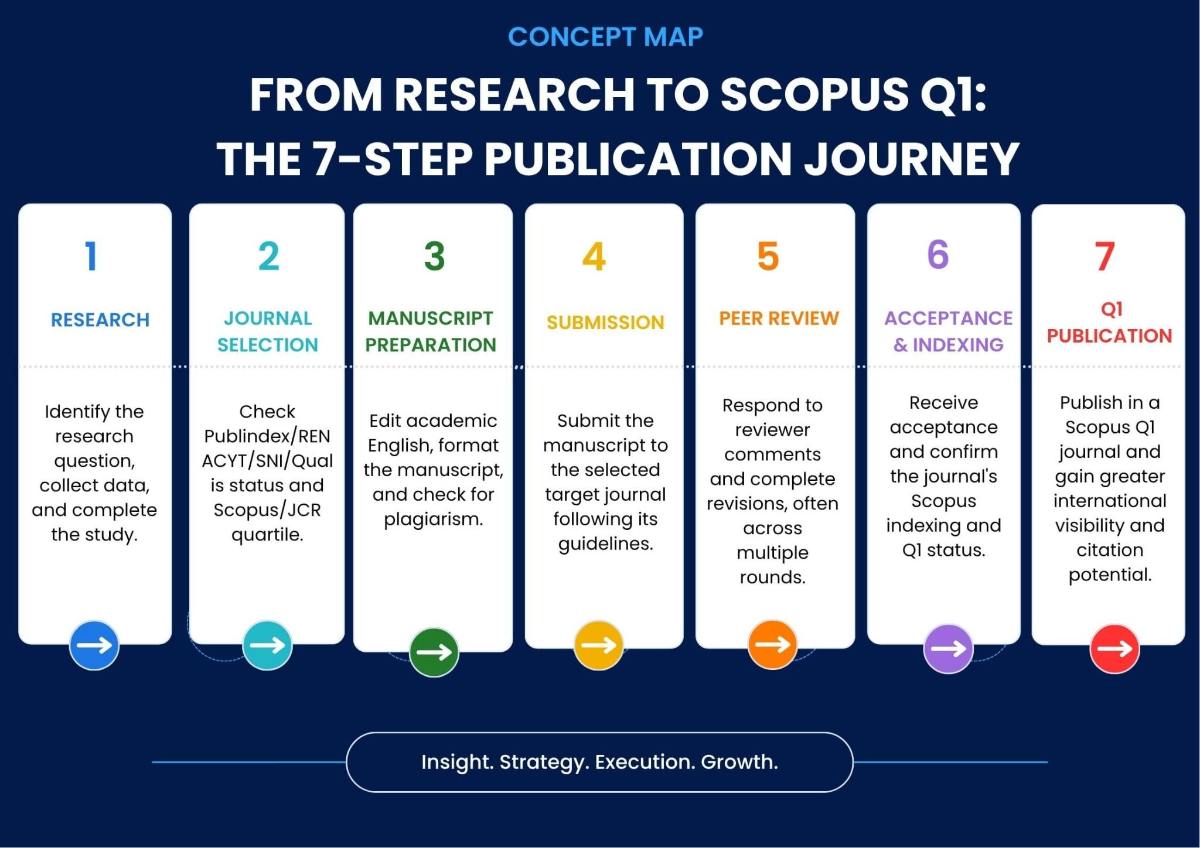
In theory, this sounds quite simple. In reality, each stage involves months of work and sometimes even restarting the process.
Stage 5, which is peer review, is particularly capricious; one round of "major revisions" alone can take anywhere from three to six months, and often the paper is rejected altogether and needs to be started anew in a new journal.
How to Publish in Q1 Journals: A Realistic Roadmap
Researchers often ask how to publish in Q1 journals as if there's a shortcut. There isn't — but there is a smarter path.
| Stage | What to Do | Why It Matters |
|---|---|---|
| Topic Selection | Choose a globally relevant angle, not just a local case study | Q1 reviewers want broader applicability |
| Journal Matching | Use Scopus/SJR portal to shortlist journals in your exact subfield | Wrong-fit journals cause instant desk rejection |
| Writing Quality | Get professional English editing if needed | Poor language is a top rejection reason |
| Data & Methods | Make sure methodology is reproducible and clearly explained | Rigor is non-negotiable for Q1 |
| Co-authorship | Collaborate with researchers who've published internationally | Mentorship shortens the learning curve |
| Persistence | Expect at least one rejection before acceptance | It's normal, not a failure signal |
Q1 journal publication is less about luck and more about preparation done correctly, repeatedly.
Maintaining a short list of three to five journals which are feasible and appropriate rather than ranking journals based on prestige ensures that a rejection by one does not kill the whole effort.
Why Publishing in Scopus Journals Still Matters for the Region
Publication in Scopus journals increases exposure for Latin American scholarship that would otherwise go unnoticed. This enables the results from this region to be incorporated into the international dialogue.
Research paper publication by professors of universities in the upper quartile of the journals will not only improve the rankings of the universities globally but also open up opportunities for international funding.
Bridging the Gap: What Institutions Can Do
Some of the feasible measures that could be adopted by universities and ministries in the region include:
- Institutional English writing workshops for academics
- Providing subsidies for APCs to early-career researchers
- Mentorship program between senior and junior faculty members
- Increasing the institutional subscription to citation indexes
- Focusing on quality rather than quantity in promotion requirements
- Developing research offices for preparing ethics forms and other such things
None of these ideas are revolutionary; most of them are just consistent application.
One could hypothesize, without the verification of a local case study, that continuous mentoring probably has more impact on publishing success than the one-time workshop. Institutes implementing these strategies need to document their own results instead of assuming that it will be applicable in all cases.
And there is the possibility of working together on a regional level. In this case, Colombia, Peru, Mexico, and Brazil have strikingly similar difficulties – such as language, budget, and the use of databases.
Networking between researchers across countries would lower costs for each university while producing research that involves several countries and would thus be more appealing to international Q1 editors.
Final Thought
Going from top-ranked in Publindex to reaching Scopus Q1 status in the journal via talent is not how it works; talent is not the limitation in Latin America.
It is all about access, money, mentorship, and patience.
The real question is whether the environment surrounding researchers will keep pace with their aspirations or not.
Frequently Asked Questions
How are Publindex and Scopus different from each other?
Publindex ranks the Colombian journals in accordance with national criteria (A1-C), while Scopus ranks the journals into four quartiles (Q1-Q4) depending on international citation analysis.
Can a journal be ranked Q1 in Scopus if its national rank in Publindex is A1?
No, because A1 is a high rank in national terms, while Q1 is the international citation impact rank.
What is the greatest challenge to publishing articles in Q1 journals in Latin America?
Funding for article processing charges and lack of English writing skills are mentioned most often.
What is the time frame for publication in Scopus journals?
The timelines differ greatly, but you should prepare for anywhere between six months and one year, which includes the peer-review process, any revisions, and possibly another journal submission.
Is there any free help in getting into Q1 journals?
Indeed, you may use such free sources as university writing centers, open-access preprint feedback, peer mentoring, and the journal matching system provided by Scopus.