
The UAE has developed a growing research and higher education ecosystem, creating more opportunities for computer science research in areas such as artificial intelligence, machine learning, cybersecurity, cloud computing, data science, and software engineering.
However, doing research and publishing in a reputable journal are two different things. Researchers might struggle with issues related to methodology, academic writing, journal choice, peer review process, research ethics, publication norms, scarcity of resources, mentoring, work load, scientific writing, and publishing process.
What are the main challenges in scientific research in the UAE face while publishing? Let’s see.
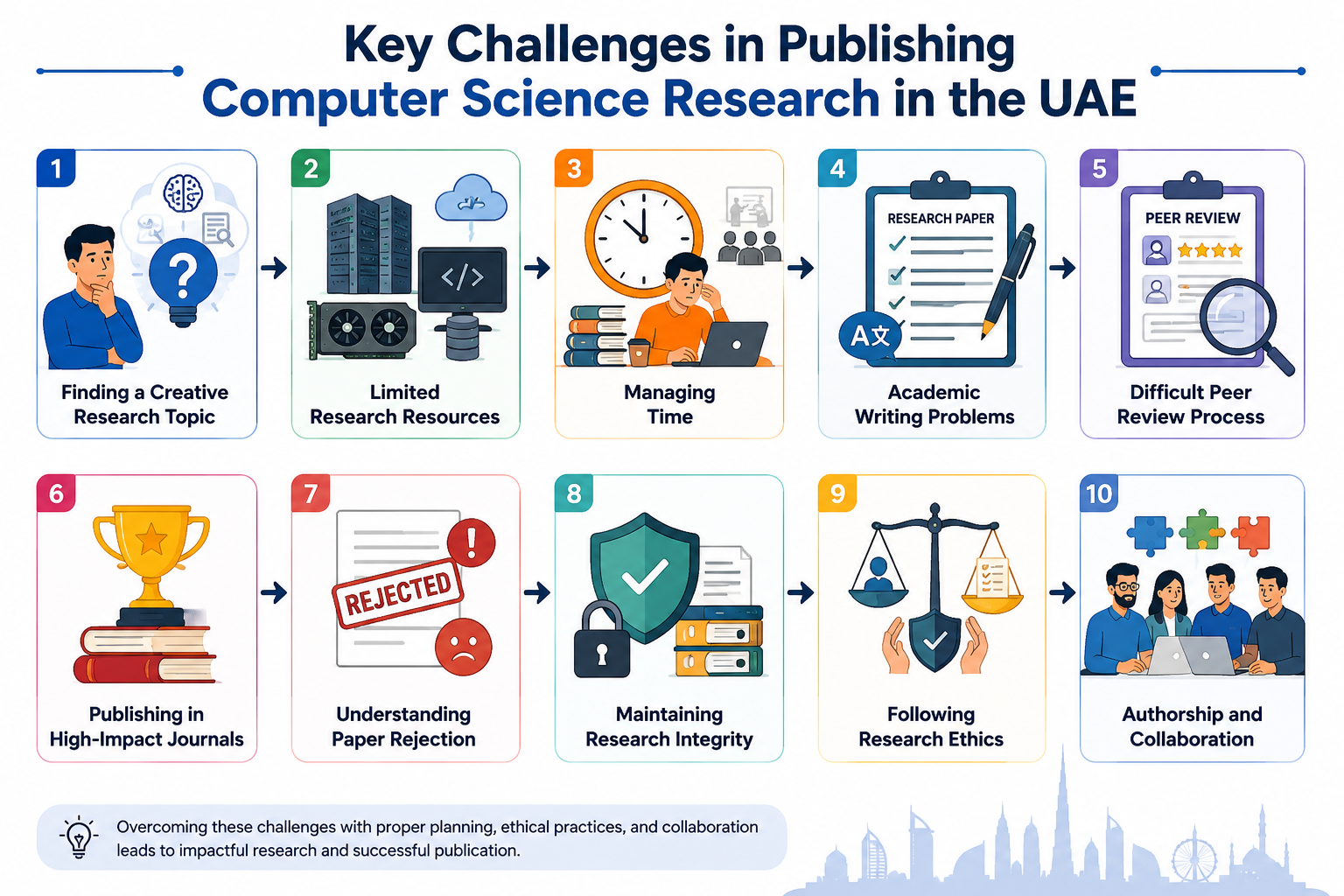
Key Challenges in Publishing Computer Science Research in the UAE
Publishing computer science research involves much more than merely conducting research. Researchers have to be creative, conduct research properly, write a well-structured paper, and live up to the expectations of credible academic journals.
The following are some of the main problems that researchers can encounter:
1. Identifying a Creative Research Topic
The first problem researchers usually face is coming up with a creative research topic.
Computer science is very competitive; there are literally thousands of papers published in this field each year. There are plenty of studies in the areas of artificial intelligence, machine learning, cybersecurity, blockchain technology, and data science.
Thus, a researcher needs to find a research gap instead of just repeating the previous research.
A strong research topic should answer:
- What problem is being addressed?
- What is missing from existing research?
- Why is the problem important?
- What is new about the proposed approach?
- How does the research improve existing knowledge?
A lack of novelty is also among the common reasons for rejection of research papers. Hence, scientists must perform an exhaustive literature review before settling on a research question.
2. Limited Research Resources and Infrastructure
High-quality computer science studies often require access to advanced technical resources.
Depending on the research area, researchers may need:
- High-performance computing systems
- GPUs and cloud infrastructure
- Large datasets
- Specialized software
- Research databases
- Programming and simulation tools
- Research laboratories
Research on the broader Arab research environment has identified inadequate funding, limited research facilities, insufficient access to databases, and a lack of technical resources as barriers to research productivity.
For researchers working on computationally intensive projects, limited access to these resources can affect the scale and quality of experiments.
3. Managing Research Alongside Other Responsibilities
Time is another important challenge.
The scientists themselves may be involved in teaching and supervision as well as other commitments related to their institutions. They may not therefore have enough time to conduct experiments and analyze their results.
The publication process itself can be lengthy, like:
- Research idea
- Literature review
- Methodology
- Experimentation
- Analysis
- Manuscript preparation
- Submission
- Peer review
- Revision
- Publication
Attention is needed for each phase. The establishment of specific time for research and realistic publication schedules could address this issue better.
4. Problems in Academic Writing
A sound technically based research has to be conveyed well too.
Academic writing challenges are common among many researchers when they write papers for international journals. Some of the problems are:
- Unclear research objectives
- Weak literature reviews
- Poor explanation of methodology
- Weak discussion sections
- Language and grammar problems
- Inconsistent terminology
- Incorrect referencing
- Failure to follow journal guidelines
Such problems may have an impact on the understanding of the contribution of the study by editors and reviewers.
Effective research paper writing is thus not only about presenting scientific results but also about clearly explaining the research gap, methodology, results, limitations, and contribution.
5. The Peer Review Process
The peer review process may be quite difficult especially for young researchers.
After submitting their manuscripts, authors first go through an editing review when the editor determines if the manuscript is appropriate for the journal. If it passes, the reviewers will consider the following aspects:
- Originality
- Methodology
- Literature review
- Technical quality
- Experimental results
- Data analysis
- Research contribution
- Ethical compliance
The manuscript may either be accepted, rejected, or asked to be revised.
Sometimes, reviewers' comments may necessitate the undertaking of further research, more comparative work, better explanation, or major revisions. Scientists should realize that revision is a normal process in scientific publishing.
6. Difficulty Publishing in High-Impact Journals
Many researchers seek out a high impact journal in order to enhance their academic status through publication in reputable journals.
Nevertheless, such journals usually have rigorous screening processes. A manuscript should be able to show that it:
- Strong originality
- Significant research contribution
- Robust methodology
- Reliable results
- Appropriate literature coverage
- Clear academic presentation
Many times researchers may look for how to publish a paper in high impact factor journals, but there is no guarantee of acceptance in such journals.
The best way is to choose a journal which really fits the research theme and then write the manuscript as per the requirement of that journal.
7. Understanding the Reasons for Rejection
Research publication inevitably involves rejection for some researchers. Some common reasons for rejection of research papers include:
| Reason | Possible Problem |
|---|---|
| Lack of novelty | The contribution is not sufficiently original |
| Scope mismatch | The paper does not fit the journal |
| Weak methodology | Research design is insufficient |
| Poor literature review | Important previous studies are missing |
| Limited experiments | Results do not adequately support claims |
| Poor writing | Research is difficult to understand |
| Weak discussion | Findings are not properly interpreted |
| Ethical concerns | Research or publication practices are questionable |
Rather than seeing the rejection as the end of the process, reviewers’ comments can be used by researchers to develop their manuscripts and publish them in other appropriate journals.
8. Challenges Related to Research Integrity
Research integrity must always be maintained during the entire research and publication process.
Publication pressure may drive researchers to pay too much attention to the number of publications they have written. Such situations may lead to problems like:
- Data fabrication or manipulation
- Plagiarism
- Duplicate publication
- Selective reporting
- Citation manipulation
- Misrepresentation of results
- Improper authorship
It is very important that researchers maintain proper documentation of their experiments, data sets, code, analyses, and choices made in their research work.
Both transparency and reproducibility gain tremendous significance in computer science due to the involvement of data sets, algorithms, and computations in research work.
9. Academic Research Ethics
In computer science research, there might also be significant ethical issues to consider.
This is particularly true for any studies conducted on human subjects, personal data, social media data, medical records, facial recognition technology, cybersecurity, and AI. Researchers need to have an understanding of the ethics at their university before undertaking these studies.
It is not just about meeting the academic research ethics guidelines in order to publish your work. It will help protect research subjects and build credibility around research.
10. Academic Authorship and Collaboration
Research in modern computer science tends to be carried out by many researchers working together. In one project alone, there may be individuals who have programmed, gathered data, experimented, analyzed, written, and supervised.
This may raise concerns with regards to academic authorship, such as:
- Who qualifies as an author?
- Who should be the first author?
- Who should be the corresponding author?
- How should author order be decided?
- What contribution is expected from each author?
These problems should ideally be discussed prior to manuscript submission.
Collaboration can also assist in solving other problems related to publishing by gaining access to additional expertise, research resources, technical know-how, and researchers.
How Can UAE Researchers Overcome These Challenges?
A researcher can take some practical measures to help them publish more effectively:
1. Enhance Research Competencies
Become proficient in research methods, statistics, experiments, and analysis of literature.
2. Become Better at Academic Writing
Practice academic paper writing and get advice from professional researchers before publishing.
3. Select Journals Cautiously
Find out about the scope of the journal, indexing, recent publications, peer-review process, publication fees, and ethics policy.
4. Establish Research Networks
Work together with researchers from other institutions, areas, and countries to have access to various resources.
5. Look for a Mentor
Learn how to do research and write papers from experienced people.
6. Be Ready for Peer-Review
Take the reviewer's comments seriously and address every single point professionally and systematically.
7. Adhere to Research Ethics
Keep records correctly, be honest when reporting results, credit others appropriately, and respect ethics requirements.
The Role of Institutional Support and Collaboration
Institutional support and collaboration will assist researchers in addressing certain challenges encountered during the publication process. These include:
- Research infrastructure: Availability of computing resources, databases, software, etc.
- Mentoring: Linking new researchers to senior academics who will mentor them on research and publishing.
- Writing assistance: Availability of workshops and training on academic writing.
- Research collaboration: Assisting researchers in collaborating with scholars from various institutions and even other countries.
- Publications: Guidance on where to publish and how to publish including knowledge of peer review processes.
- Ethics and integrity: Assistance in matters pertaining to ethics and research integrity.
These will assist the researcher in developing good quality research.
Conclusion
Publication of computer science research in the UAE may be accompanied by different problems, such as the selection of an innovative research topic, obtaining resources, handling of the research load, overcoming academic writing challenges, peer review, choosing journals and observing ethical considerations.
Research carried out in the UAE and in the Arab academic environment indicates that the problems related to the availability of resources, mentoring, research competences, scientific writing, the load, and publication system can affect research productivity.
Nevertheless, these problems may be successfully solved with the help of good research training, cooperation, mentoring, choosing of appropriate journals, proper manuscript writing, and appropriate research ethics.
For researchers, publication of a research is much more than getting their paper published. It is about conducting original, reliable and ethical research.
Frequently Asked Questions
What challenges do researchers face in computer science research in the UAE?
The challenges for researchers may be those related to research resources, research topic, academic writing, peer review, journal selection, research ethics, and publishing.
Why are computer science research papers rejected?
It could be due to several factors such as novelty, methodology, literature review, experiments, scope and poor presentation.
How do computer scientists publish their work?
Computer scientists need to perform their work, employ methodology, write the manuscript effectively, and select a suitable journal to which to respond to the reviewer’s comments.
How can researchers from UAE enhance their publication process?
This can be achieved by improving research skills, getting mentorship, developing networks for research, academic writing, and selecting journals appropriately.
Why are research integrity and academic research ethics necessary?
These are very much important as they help researchers conduct research responsibly